
An ISO 7 cleanroom is a controlled environment that must contain no more than 352,000 particles at or above 0.5 µm, 83,200 particles at or above 1.0 µm, and 2,930 particles at or above 5.0 µm per cubic meter of air. ISO 7 is defined by ISO 14644-1 and is also commonly associated with the former Federal Standard Class 10,000 designation. Many ISO 7 designs begin with 30–60 air changes per hour (ACH), terminal HEPA filtration and a positive pressure differential, but ISO 14644-1 does not prescribe one universal ACH, pressure or filter layout. Those engineering values must be selected for the process, contamination load and required recovery time.
ISO 7 cleanrooms are widely used for pharmaceutical support rooms, medical device manufacturing, laboratories, precision assembly and controlled packaging. Compliance depends on the complete room system: airflow, filtration, pressure cascade, cleanable construction, personnel and material movement, operating procedures, monitoring and documented testing.
ISO 7 Cleanroom Requirements at a Glance
| Requirement | ISO 7 value or typical design range | How to interpret it |
|---|---|---|
| Particles ≥0.5 µm | Maximum 352,000 particles/m³ | ISO 14644-1 classification limit |
| Particles ≥1.0 µm | Maximum 83,200 particles/m³ | ISO 14644-1 classification limit |
| Particles ≥5.0 µm | Maximum 2,930 particles/m³ | ISO 14644-1 classification limit |
| Legacy equivalent | FED-STD-209E Class 10,000 | Common historical comparison, not the current governing standard |
| Air changes per hour | Often 30–60 ACH as an initial design range | Not mandated by ISO 14644-1; some processes require more |
| Room pressure | Often +10 to +15 Pa to an adjacent less-clean room | A common project value, not a universal ISO requirement |
| Filtration | Terminal HEPA filtration is commonly used | Filter grade, coverage and arrangement depend on the airflow design |
| Airflow pattern | Non-unidirectional mixed airflow is common | Local ISO 5 protection may be added over a critical process |
| Classification state | As-built, at-rest or operational | The required state must be agreed before design and validation |
The particle limits above are classification requirements. ACH, pressure differential and filter coverage are engineering decisions used to achieve and maintain those limits. A supplier proposal should clearly separate mandatory acceptance criteria from preliminary design assumptions.
What Is an ISO 7 Cleanroom?
ISO 7 is one of the airborne-particle cleanliness classes defined by ISO 14644-1. A lower class number represents a cleaner environment, so ISO 7 is cleaner than ISO 8 but less stringent than ISO 6 or ISO 5. For a broader explanation of the classification system, see our ISO 14644 cleanroom classification guide.
ISO 7 describes airborne particle concentration; it does not by itself define microbial limits, temperature, humidity, gowning, room pressure, cleaning chemicals or process-specific controls. Those requirements may come from a user requirement specification (URS), a pharmaceutical quality system, medical device controls, customer standards or other regulations.
ISO 7 is often called Class 10,000 because the obsolete FED-STD-209E system allowed up to 10,000 particles of 0.5 µm and larger per cubic foot. The two terms are commonly treated as equivalent in project discussions, but new specifications should use ISO 14644 terminology and metric particle concentrations.
ISO 7 Particle Count Limits
The defining requirement for ISO 7 is the maximum permitted concentration of airborne particles. The room must be tested with a calibrated particle counter using an approved sampling plan. Room area, number of sampling locations, sample volume, particle sizes, test state and acceptance criteria should be documented before testing begins.
| Particle size | Maximum concentration for ISO Class 7 |
|---|---|
| ≥0.1 µm | 35,200,000 particles/m³ |
| ≥0.2 µm | 8,320,000 particles/m³ |
| ≥0.3 µm | 3,520,000 particles/m³ |
| ≥0.5 µm | 352,000 particles/m³ |
| ≥1.0 µm | 83,200 particles/m³ |
| ≥5.0 µm | 2,930 particles/m³ |
A room does not pass simply because one sample is below the limit. Classification must follow the agreed sampling plan and test condition. High counts can be caused by filter leakage, poor airflow distribution, unsealed penetrations, door activity, insufficient cleaning, equipment emissions or operator movement. Our cleanroom particle count testing guide explains sampling, common failures and preparation for certification.
How Many Air Changes per Hour Does ISO 7 Need?
A practical starting range for many ISO 7 cleanrooms is 30–60 air changes per hour. However, this is a design benchmark rather than an ISO 14644-1 requirement. Some rooms can achieve the target near the lower end, while high particle loads, short recovery requirements, dense equipment or difficult layouts may require 60–90 ACH or another project-specific value.
ACH should not be selected in isolation. The engineer should consider room volume, occupancy, process emissions, heat load, outdoor-air demand, HEPA ceiling coverage, supply velocity, return-air location, equipment obstruction and recovery time after a door opening or contamination event. A high ACH number cannot correct short-circuiting airflow or dead zones.
For many ISO 7 rooms, non-unidirectional or turbulent mixed airflow with terminal HEPA filtration is practical. If a process needs stronger local protection, an ISO 5 unidirectional airflow zone, laminar flow hood or restricted-access system may be installed inside the ISO 7 background room.
ISO 7 Pressure Differential
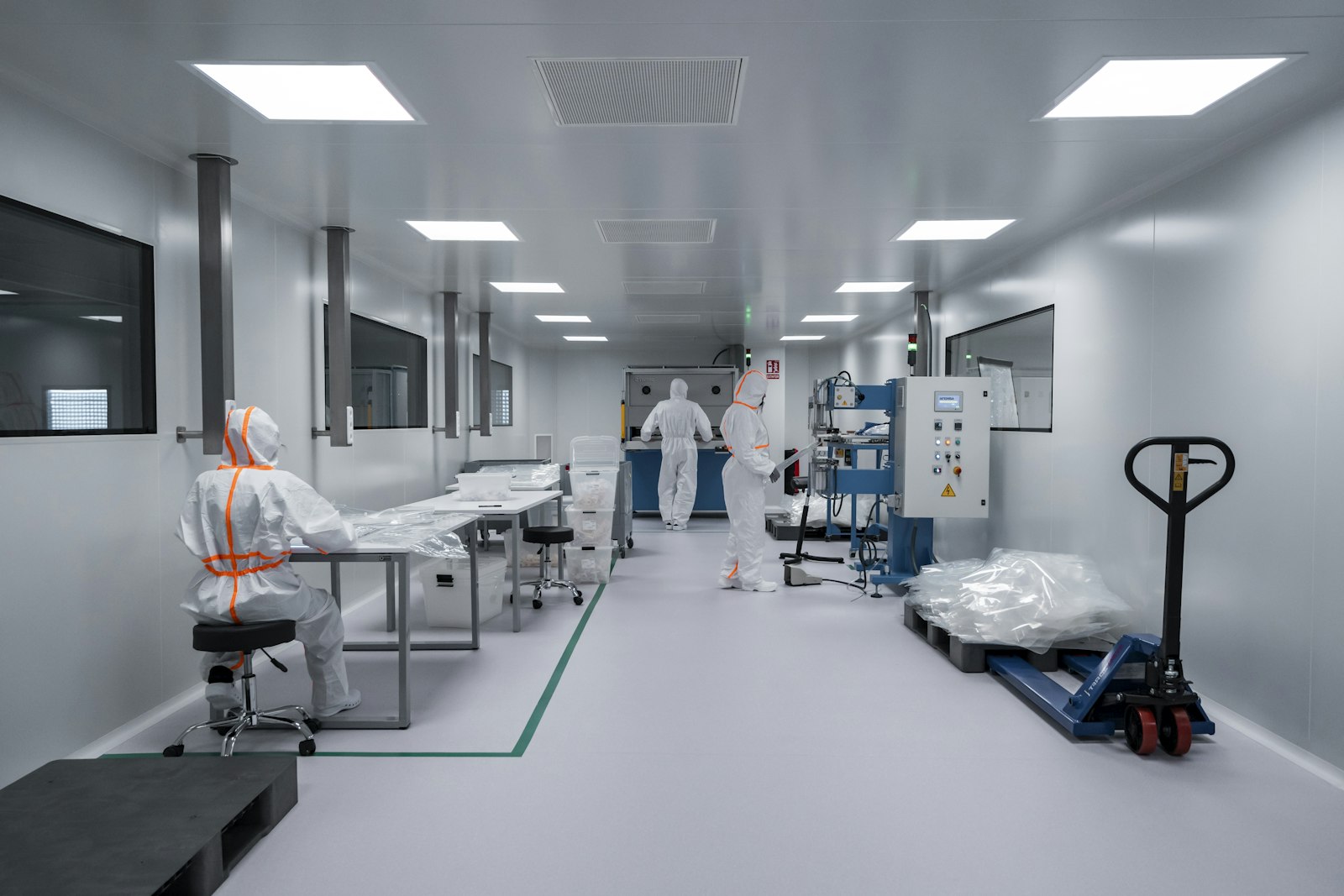
ISO 7 cleanrooms are commonly maintained at positive pressure relative to adjacent less-clean spaces so air moves outward when leakage occurs. A frequently used initial design value is 10–15 Pa between rooms of different cleanliness, but this is not a universal ISO 7 requirement. The correct setpoint depends on the contamination-control strategy, door arrangement, exhaust load and governing regulation.
The pressure cascade should be shown on a room-by-room schedule. Designers must account for door undercuts, transfer hatches, pass boxes, air showers, process exhaust and simultaneous door openings. Pressure should remain stable enough for normal operation, and recovery after a door event should be demonstrated where required.
Hazardous, potent or infectious processes may require negative pressure for containment even when the room is particle-classified as ISO 7. In that case, personnel protection and product protection must be evaluated together. See our detailed guide to cleanroom pressure differential control.
HEPA Filtration and HVAC Design
Terminal HEPA filtration is commonly used for ISO 7 cleanrooms, but ISO classification does not prescribe one specific HEPA grade. The design should define filter efficiency, terminal housing, ceiling coverage, supply airflow, pre-filtration, replacement access and the method for filter integrity testing. A higher filter grade alone cannot compensate for weak sealing, poor room airflow or unstable pressure.
An AHU-based cleanroom system can efficiently serve larger suites that need temperature, humidity, fresh-air and pressure control. FFU-based layouts can suit modular rooms or facilities that need flexible ceiling coverage. Selection should be based on room size, process heat load, redundancy, maintenance access, energy use and future expansion.
Filter integrity testing should be part of commissioning and periodic recertification where required. The filter, housing and seals are tested as an installed system; relying only on the filter manufacturer’s factory certificate is not enough to prove field performance.
At-Rest vs Operational ISO 7 Classification
The required occupancy state has a major effect on performance. An ISO 7 room can be classified in one or more of the following states:
- As-built: the room is complete and operating, but production equipment, materials and personnel are absent.
- At-rest: production equipment is installed and operating as agreed, but personnel are absent.
- Operational: the room is running with the specified number of personnel and the agreed process activity.
People and process movement are often the largest particle sources. A cleanroom may pass at-rest testing and fail during operation if gowning, cleaning, material transfer, equipment layout or airflow recovery is weak. The URS and supplier quotation should state the required test state rather than simply saying “ISO 7.”
ISO 7 vs ISO 8 Cleanrooms
| Comparison | ISO 7 | ISO 8 |
|---|---|---|
| Maximum particles ≥0.5 µm | 352,000 particles/m³ | 3,520,000 particles/m³ |
| Maximum particles ≥5.0 µm | 2,930 particles/m³ | 29,300 particles/m³ |
| Typical airflow demand | Higher | Lower |
| Common use | Controlled production and cleaner support rooms | Gowning, preparation, packaging and less-sensitive support areas |
| Relative capital and operating cost | Usually higher | Usually lower |
ISO 7 is ten times stricter than ISO 8 at the listed particle sizes. The correct class should be chosen from product and process risk, not from a preference for the lowest possible class. Over-classification increases airflow, filter, controls, validation and energy costs without necessarily improving the process.
Is ISO 7 the Same as EU GMP Grade C?
ISO 7 and EU GMP Grade C are related but should not be treated as universally interchangeable. Grade C has defined pharmaceutical applications and includes requirements beyond airborne non-viable particle classification. Depending on the required state and applicable GMP version, an ISO class may help describe part of the environmental target, but viable monitoring, gowning, cleaning, qualification and process controls must also be addressed.
For pharmaceutical projects, define both the applicable GMP grade and ISO classification where needed. Do not approve a room for Grade C operation solely because an ISO 7 particle test passed. Our GMP cleanroom requirements guide covers the wider facility and documentation considerations.
Gowning, Behavior and Prohibited Items
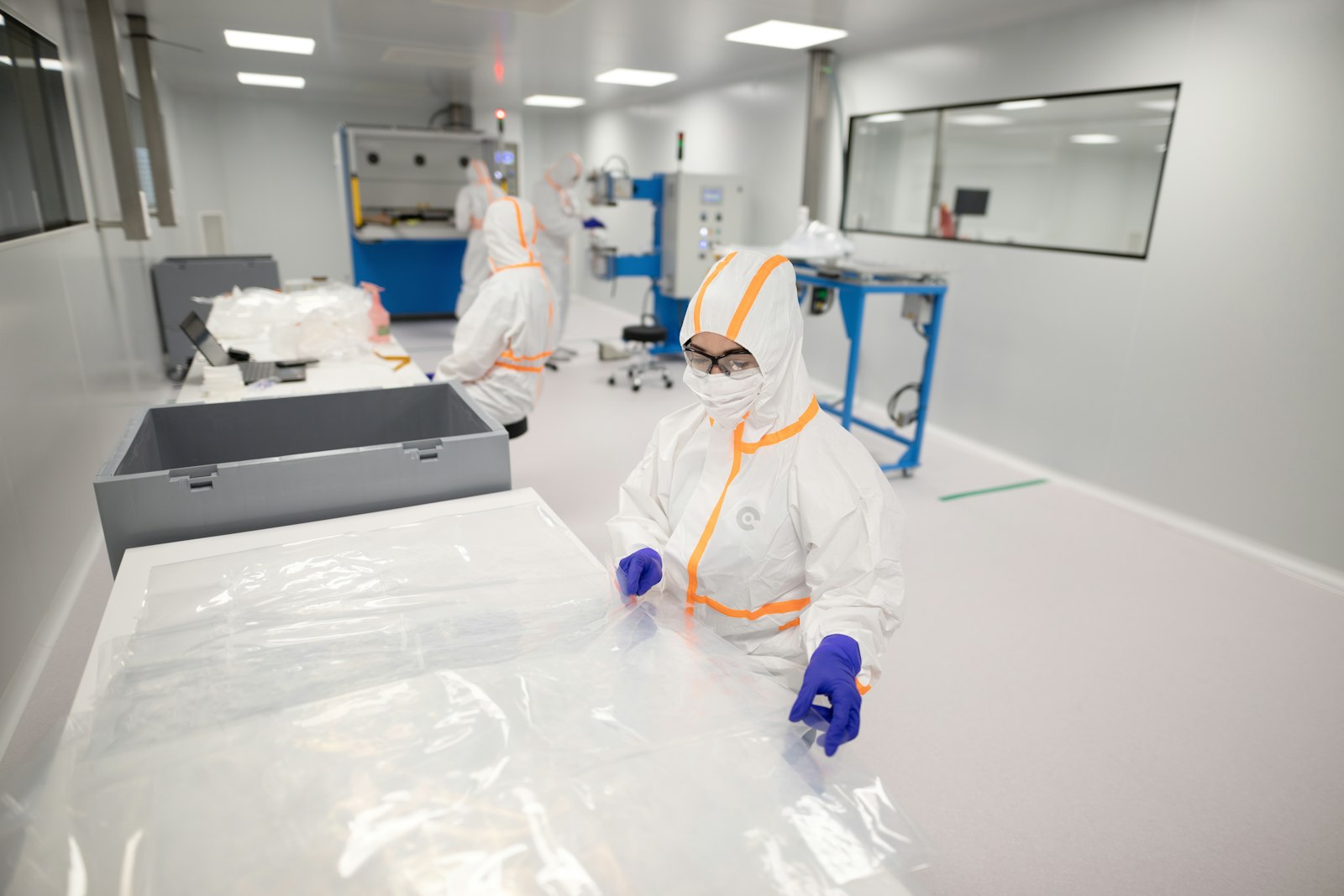
ISO 14644-1 does not prescribe one universal ISO 7 gowning set. Facilities normally use a risk-based procedure that may include a bouffant cap or hood, beard cover, face mask, cleanroom coat or coverall, gloves and dedicated shoes or shoe covers. Garment selection should reflect product risk, operator exposure and the contamination-control strategy.
Commonly prohibited items include food, drinks, chewing gum, cosmetics, jewelry, loose paper, cardboard and uncontrolled personal belongings. Fast movement, unnecessary conversation, incorrect glove contact and doors held open can also increase contamination. Training and routine observation are therefore part of maintaining ISO 7 performance.
Materials, Layout and Cleanability
Walls, ceilings, floors, windows and doors should be smooth, sealed, non-shedding and compatible with the selected cleaning agents. Coved flooring, flush details and sealed penetrations reduce particle traps. Equipment should be positioned so operators can clean and maintain it without blocking supply air or return paths.
Personnel and material routes should be planned together. Gowning rooms, airlocks, pass boxes and waste routes need enough space and a logical sequence. If pallets, carts or maintenance tools cross directly from uncontrolled areas into the ISO 7 room, the room may pass initial classification but struggle during routine production.
ISO 7 Validation and Handover Checklist
Classification is one part of a complete handover package. The exact test scope should be agreed in the URS, validation plan and supplier contract.
- Approved room data sheet and layout showing the ISO 7 boundary.
- Particle count classification under the agreed occupancy state.
- Supply airflow volume, air-change calculation and balancing report.
- Room pressure differential verification and alarm checks.
- Airflow visualization or smoke study where required.
- Temperature and relative-humidity verification.
- Installed HEPA filter integrity testing where applicable.
- Recovery testing if specified by the process or standard.
- Calibration certificates for test instruments.
- As-built drawings, operating manuals and preventive-maintenance plan.
- Cleaning, gowning and material-transfer procedures.
- Final deviation record and validation report.
Hurricane Techs provides cleanroom validation and performance testing together with design, HVAC integration, cleanroom construction and commissioning support. For a useful quotation, provide the room dimensions, process, target test state, occupancy, heat load, pressure relationships, temperature and humidity limits, and required documentation.
FAQ
What is the ISO Class 7 particle limit?
The maximum concentration is 352,000 particles/m³ at or above 0.5 µm, 83,200 particles/m³ at or above 1.0 µm, and 2,930 particles/m³ at or above 5.0 µm. Classification must be performed using the agreed ISO 14644-1 sampling plan and room state.
How many air changes does an ISO 7 cleanroom need?
Many designs use 30–60 ACH as an initial range, but ISO 14644-1 does not mandate a single value. The final ACH must be justified using contamination load, room layout, recovery time, heat load, filter coverage and operational activity.
Does an ISO 7 cleanroom require positive pressure?
Positive pressure is common when the objective is to protect the product from adjacent less-clean spaces. A 10–15 Pa differential is often used as a starting point. Containment processes may instead require negative pressure, so the pressure direction and setpoint must be defined by risk.
Is ISO 7 the same as Class 10,000?
ISO 7 is commonly considered the modern equivalent of Federal Standard Class 10,000. New specifications should use ISO 14644-1 terminology because FED-STD-209E has been withdrawn.
Is ISO 7 suitable for pharmaceutical manufacturing?
ISO 7 is frequently used for pharmaceutical support rooms and selected production areas. The final requirement also depends on the applicable GMP grade, product type, process step, sterile or non-sterile operation and contamination-control strategy.
What items are prohibited in an ISO 7 cleanroom?
Facilities commonly prohibit food, drinks, cosmetics, jewelry, cardboard, uncontrolled paper and personal belongings. The final prohibited-item list and gowning procedure should be defined by the facility’s contamination-control risk assessment.
How often should an ISO 7 cleanroom be recertified?
The interval depends on the governing standard, industry, customer requirements and quality system. Regulated facilities should establish a documented monitoring and recertification schedule and repeat testing after significant HVAC, filter, layout or process changes.


