
An ISO 14644 cleanroom is a controlled environment classified by airborne particle concentration, mainly under ISO 14644-1. The standard defines how clean the air must be at specified particle sizes, how the class is expressed, and how particle counts are verified. It does not automatically define air changes per hour, room pressure, temperature, humidity, gowning level or microbial limits. Those engineering and operating requirements must be selected for the product, process risk and regulatory context.
For project buyers, the ISO class is the starting point for the cleanroom specification. It affects airflow volume, HEPA or ULPA filter selection, room pressure cascade, layout, validation scope and operating cost. A lower ISO class number means stricter particle limits, so an ISO 5 cleanroom is cleaner than ISO 7, and ISO 7 is cleaner than ISO 8.
ISO 14644 Cleanroom Requirements at a Glance
| Question | Short answer | Project implication |
|---|---|---|
| What does ISO 14644 classify? | Airborne particle cleanliness in cleanrooms, clean zones and related controlled environments | The class target must be translated into airflow, filtration, pressure, layout and validation requirements |
| Which part is most important for classification? | ISO 14644-1 | Use it to define particle concentration limits and cleanroom class acceptance |
| Which part covers ongoing compliance? | ISO 14644-2 | Use it to plan monitoring and periodic requalification after the room is in service |
| Does ISO 14644 define ACH? | No universal ACH is prescribed | Air changes are design assumptions used to achieve the selected class under real process conditions |
| Does ISO 14644 define microbial limits? | No, ISO 14644-1 is about airborne particles | Pharmaceutical and sterile projects usually need GMP or microbiological control requirements in addition |
What ISO 14644-1 Actually Classifies
ISO 14644-1 classifies the cleanliness of air by measuring cumulative concentrations of airborne particles equal to or larger than specified sizes. In many industrial projects, the most frequently discussed classes are ISO 5, ISO 6, ISO 7 cleanroom and ISO 8, because they cover many pharmaceutical support rooms, medical device areas, electronics assembly rooms, laboratories and controlled packaging zones.
The standard gives the acceptance framework for particle concentration. It does not design the room. A supplier still needs to define the airflow concept, terminal filter coverage, return-air path, pressure relationship, door strategy, personnel and material flow, wall and floor finishes, cleaning method and validation plan that make the class achievable.
The official ISO description of ISO 14644-1:2015 confirms that classification is based on airborne particle concentration in cleanrooms, clean zones and separative devices, using light-scattering airborne particle counters at designated sampling locations. It also states that the standard does not characterize the physical, chemical, radiological, viable or other nature of airborne particles. That distinction matters: an ISO 14644 cleanroom particle class is not the same thing as a complete GMP, biosafety or process-control specification.
ISO 14644 Cleanroom Class Particle Limits
The table below gives a practical view of common ISO cleanroom particle limits per cubic meter of air. For higher-number classes, smaller particle sizes may not be practical or normally specified in the standard table. Blank cells should not be interpreted as zero particles; they indicate that the size is not normally used as a classification limit for that class.
| ISO class | ≥0.1 µm | ≥0.2 µm | ≥0.3 µm | ≥0.5 µm | ≥1.0 µm | ≥5.0 µm | Common use |
|---|---|---|---|---|---|---|---|
| ISO 3 | 1,000 | 237 | 102 | 35 | — | — | Very high precision environments |
| ISO 4 | 10,000 | 2,370 | 1,020 | 352 | 83 | — | Advanced precision and critical micro-contamination control |
| ISO 5 | 100,000 | 23,700 | 10,200 | 3,520 | 832 | — | Critical zones, filling points and local clean-air protection |
| ISO 6 | 1,000,000 | 237,000 | 102,000 | 35,200 | 8,320 | 293 | Sensitive assembly and controlled production |
| ISO 7 | — | — | — | 352,000 | 83,200 | 2,930 | Pharmaceutical support rooms, medical device manufacturing and laboratories |
| ISO 8 | — | — | — | 3,520,000 | 832,000 | 29,300 | Packaging, gowning, corridors and general controlled rooms |
| ISO 9 | — | — | — | 35,200,000 | 8,320,000 | 293,000 | Basic controlled indoor reference environment |
Most cleanroom quotations should state the target ISO class, the particle sizes used for acceptance, the occupancy state for testing and the applicable validation standard. A proposal that only says “HEPA cleanroom” or “Class 10,000 room” is incomplete unless it also defines the ISO 14644 cleanroom class and test basis.
ISO 14644 vs Federal Standard 209E
Older project documents may still use Federal Standard 209E terms such as Class 100, Class 1,000, Class 10,000 or Class 100,000. The old federal standard has been superseded, but the terminology remains common in supplier conversations. For new specifications, ISO class terminology should be used because it is the current international language for cleanroom classification.
| Current ISO class | Common legacy comparison | Important note |
|---|---|---|
| ISO 5 | Class 100 | Often used for critical zones rather than whole-room coverage |
| ISO 6 | Class 1,000 | Requires stronger airflow and filtration control than ISO 7 |
| ISO 7 | Class 10,000 | Common for regulated support rooms and many manufacturing areas |
| ISO 8 | Class 100,000 | Common for packaging, corridors, gowning and less critical rooms |
The legacy comparison is useful for communication, but it should not replace a current ISO 14644 cleanroom specification. Test method, particle size, occupancy state and documentation requirements still need to be defined.
At-Rest, As-Built and Operational Cleanroom Testing
ISO 14644 cleanroom classification depends not only on the class number but also on the state in which the room is tested. This is one reason two rooms with the same nominal class can perform differently in production.
| Testing state | Meaning | When it matters |
|---|---|---|
| As-built | The room is complete with services operating, but without equipment, materials or personnel | Useful for installation verification, but not enough to prove production performance |
| At-rest | Equipment is installed and operating, but personnel and active production are absent | Common for project acceptance and baseline qualification |
| Operational | The room is running under normal personnel, material and process activity | Critical when people, process movement or equipment emissions are major particle sources |
At-rest compliance is easier to achieve than operational compliance. If the real process has frequent door opening, high personnel movement, powder handling, open product exposure or complex material transfer, the design should be tested against those conditions instead of relying only on an empty-room result.
How ISO 14644 Affects Cleanroom Design
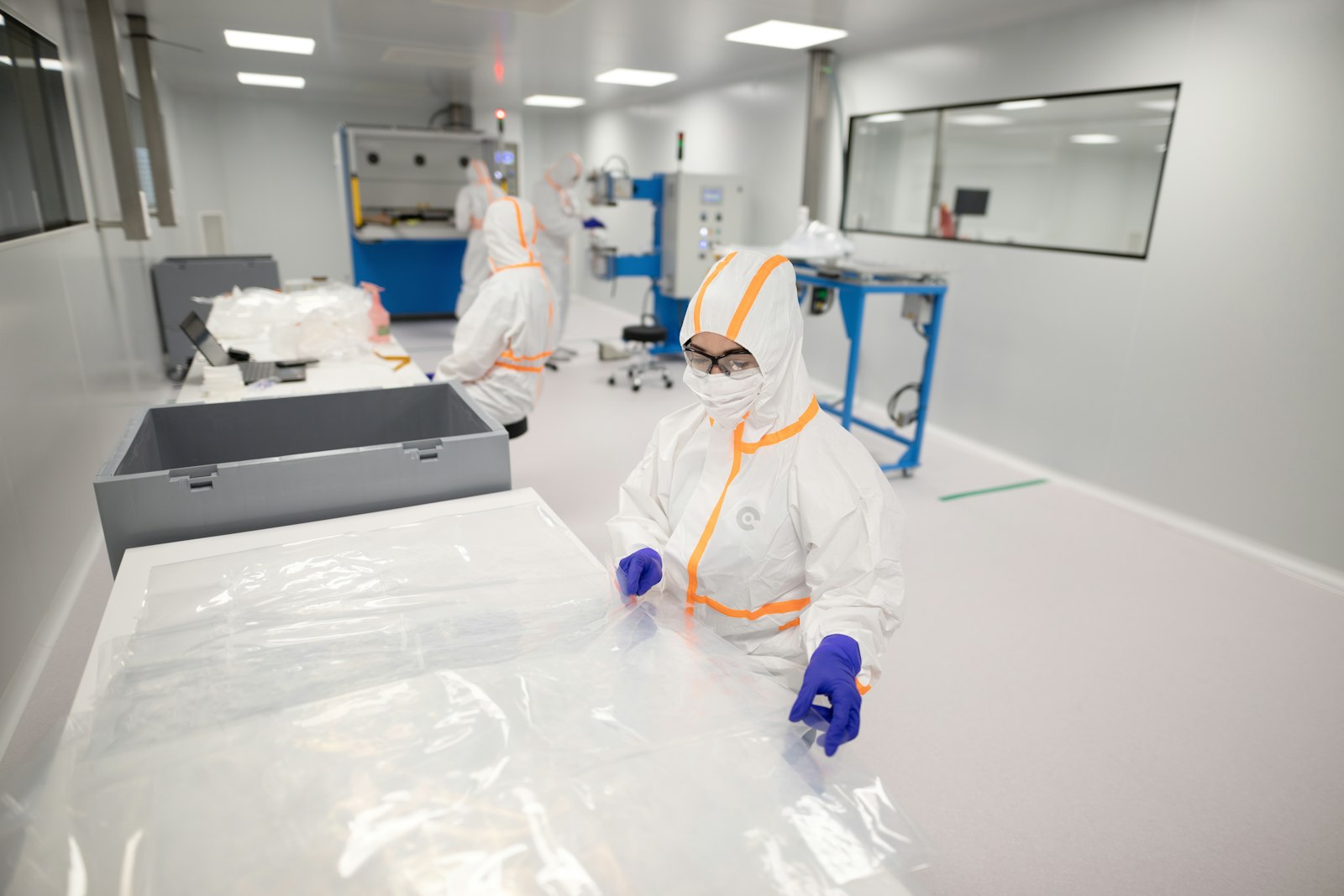
The ISO class influences the design, but it is not a complete design recipe. A lower class normally requires stronger control of filtration, airflow pattern, leakage, pressure cascade and contamination sources. In a turnkey project, the ISO 14644 cleanroom target should be connected to the following decisions:
- Airflow volume and air changes: ISO 14644 does not prescribe one ACH value. The design team estimates airflow based on particle load, heat load, room layout, recovery target and process activity.
- Filter strategy: Terminal HEPA filtration is common for many cleanrooms. ULPA filtration may be used for stricter particle-control requirements, especially in high-end electronics or special precision processes.
- Pressure cascade: Cleaner rooms usually need positive pressure toward adjacent less-clean areas, while containment or hazardous processes may need a different pressure strategy.
- Return-air path: High sidewall returns, low returns, ceiling returns or raised-floor returns should match the airflow pattern and contamination risk.
- Personnel and material flow: Gowning, pass boxes, airlocks and door interlocks can be as important as the AHU and filters.
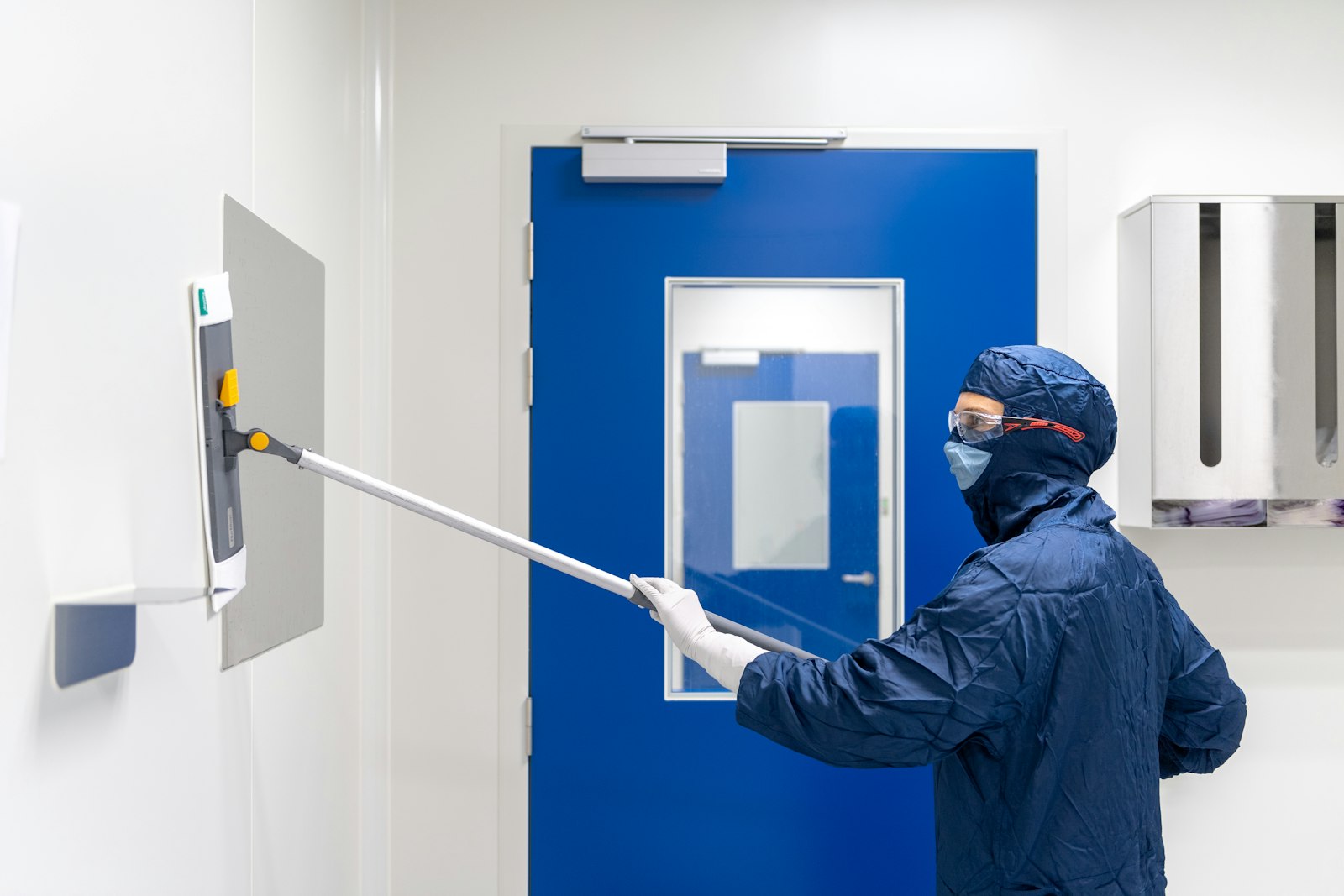
- Cleaning and maintenance: A room that passes on the first day can fail later if cleaning, filter testing, pressure monitoring and operating discipline are weak.
For example, an ISO 7 cleanroom may use terminal HEPA filtration with a cleanroom AHU, while an ISO 5 local critical zone may use FFUs, laminar flow equipment or local clean-air protection. The class target should lead to a system design, not a single product choice.
ISO 14644-1, ISO 14644-2 and ISO 14644-3: What Each Part Means
Many buyers say “ISO 14644” when they mainly mean ISO 14644-1. In practice, several parts of the standard family may affect a project:
| Standard part | Main role | How it affects a project |
|---|---|---|
| ISO 14644-1 | Classification of air cleanliness by particle concentration | Defines class limits and classification acceptance basis |
| ISO 14644-2 | Monitoring to provide evidence of cleanroom performance related to air cleanliness | Supports ongoing compliance plans and requalification strategy |
| ISO 14644-3 | Test methods | Supports test planning for particle counts, airflow, pressure, recovery and related performance checks |
| ISO 14644-4 | Design, construction and start-up | Helps frame design and construction expectations |
| ISO 14644-5 | Operations | Supports operating procedures, cleaning and control practices |
A cleanroom project should not stop at the particle class table. The user requirement specification should identify which ISO 14644 parts and which industry-specific standards apply, especially for pharmaceutical, medical device, food, laboratory and electronics applications.
Validation Tests Buyers Should Expect
A complete cleanroom validation package normally includes more than a particle count certificate. The exact scope depends on the project, but buyers should expect the supplier to discuss:
- Airborne particle count testing for the agreed ISO class and occupancy state.
- Airflow volume or velocity testing to confirm the air system is delivering the design condition.
- Room pressure differential testing to verify the pressure cascade.
- HEPA filter integrity testing, especially for terminal filters and critical zones.
- Temperature and humidity checks when the process or product requires environmental control.
- Recovery testing where the room must return to class after a contamination event or door opening.
- Documentation that states instruments, calibration status, sampling locations, acceptance criteria and final results.
For regulated projects, documentation quality is as important as test execution. A report should make it clear whether the room was tested as-built, at-rest or operational, and which particle sizes were used for acceptance.
Common Mistakes in ISO 14644 Cleanroom Projects
- Choosing a class before defining the process risk. The right class depends on product exposure, contamination sensitivity, regulatory expectations and operating activity.
- Using filter grade as a shortcut for cleanroom class. H14 HEPA filters do not automatically make a room ISO 7 or ISO 5. Air distribution, leakage, particle sources and operation also matter.
- Ignoring the testing state. A room that passes at-rest may not pass operational testing if people, materials or equipment generate heavy particle loads.
- Comparing quotations without validation scope. Two suppliers may quote the same ISO class but include very different testing, documentation and monitoring packages.
- Mixing ISO and GMP terms loosely. ISO classes and EU GMP grades are related in practice but not interchangeable. GMP projects need a wider contamination-control strategy.
- Copying ACH values from another project. Air changes are design assumptions, not universal ISO 14644 requirements.
How to Specify an ISO 14644 Cleanroom in a Supplier RFQ
To receive comparable quotations, give suppliers a clear technical basis instead of only asking for “an ISO cleanroom.” A practical RFQ should define:
| RFQ item | What to specify | Why it matters |
|---|---|---|
| Target class | ISO 5, ISO 6, ISO 7, ISO 8 or another required class | Sets the particle concentration target and cost level |
| Room state | As-built, at-rest, operational or multiple states | Defines the real acceptance condition |
| Particle sizes | For example ≥0.5 µm and ≥5.0 µm where applicable | Avoids vague pass/fail criteria |
| Process description | People count, equipment, material movement, heat load and contamination source | Allows a realistic airflow and pressure design |
| Regulatory context | GMP, medical device, electronics, laboratory or internal QA requirement | Determines whether extra controls are required beyond ISO 14644 |
| Validation package | Tests, reports, instruments and calibration records | Makes supplier offers comparable |
Related Hurricane Techs Resources
- ISO 7 Cleanroom Requirements: Particle Limits, ACH and Pressure
- Cleanroom Particle Count Testing Guide
- Cleanroom Design & Consulting
- Validation & Performance Testing
- HEPA / ULPA High-Efficiency Air Filters
FAQ
What is an ISO 14644 cleanroom?
An ISO 14644 cleanroom is a cleanroom or clean zone classified by airborne particle concentration using the ISO 14644 standard family, especially ISO 14644-1 for classification by particle concentration.
Is ISO 14644 the same as GMP?
No. ISO 14644 defines particle cleanliness classification and related cleanroom performance concepts. GMP requirements may also cover microbial control, contamination control strategy, documentation, personnel behavior, process risk and regulatory quality systems.
Does ISO 14644 define air changes per hour?
No. ISO 14644 does not give one universal ACH value for each class. Air changes are engineering design values selected to achieve the required particle class under the expected process load and room layout.
What is the difference between ISO 7 and ISO 8 cleanrooms?
ISO 7 is cleaner than ISO 8. At ≥0.5 µm, ISO 7 allows up to 352,000 particles per cubic meter, while ISO 8 allows up to 3,520,000 particles per cubic meter.
How often should an ISO 14644 cleanroom be tested?
The testing frequency depends on the classification, process risk, monitoring plan and applicable regulatory requirements. Many projects combine periodic particle count testing with pressure, airflow, filter integrity and environmental monitoring.


