
Cleanroom particle count testing measures airborne particles to confirm whether a room meets its target class. It is one of the most visible acceptance tests, but the result depends on the sampling plan, room state, airflow stability, cleaning discipline and operator activity. A pass or fail number is only useful when the method and acceptance criteria are clearly defined.
Buyers should treat a cleanroom particle count test as part of the complete validation plan. The test should connect to ISO 14644 classification, room layout, HEPA integrity, airflow balancing and operating procedure. When the result fails, the team should be able to trace whether the issue is filtration, airflow, cleaning, construction residue, test setup or process activity.
This guide explains what a particle count test measures, how sampling locations and volumes are established, how a cleanroom particle counter should be prepared, and what information belongs in a defensible classification or recertification report.
Cleanroom Particle Count Testing at a Glance
- Purpose: demonstrate airborne particle concentration against an agreed ISO class or project limit.
- Instrument: a calibrated light-scattering airborne particle counter with suitable size channels and flow rate.
- Test condition: as-built, at-rest or operational, defined before sampling begins.
- Sampling plan: required locations and sample volume based on room area, target class, particle size and applicable protocol.
- Result: documented counts by location and particle size, supported by instrument, room-state and corrective-action records.
A clean room particle count is not simply a reading taken in the center of the room. Classification depends on representative locations, controlled test conditions and a method that another qualified technician can repeat. Process monitoring may use different locations and frequencies because it is designed to detect trends and risk, rather than to repeat the entire classification exercise every day.
What Particle Count Testing Measures
The test counts airborne particles at specified threshold sizes and compares the measured concentration with the applicable class limit. For ISO classification, light-scattering airborne particle counters are used to measure particles equal to or larger than the selected sizes at designated sampling locations.
The report should identify the cleanroom class, occupancy state, sample locations, sample volume, particle-size channels, counter flow rate and instrument calibration status. Without those details, the result is difficult to repeat and weak as acceptance evidence.
For a practical classification example, review the ISO 7 cleanroom particle limits before defining the sampling plan and acceptance criteria. For ISO Class 7, commonly referenced maximum concentrations are 352,000 particles/m³ at and above 0.5 µm, 83,200 particles/m³ at and above 1.0 µm, and 2,930 particles/m³ at and above 5.0 µm. The project protocol still needs to state which particle sizes apply to the classification and how results will be reported.
Particle testing does not identify the biological, chemical or physical composition of each particle. It also does not diagnose every contamination problem by itself. It records a measured airborne condition at a defined time and place. To understand the result, review it together with airflow pattern, pressure differential, filter integrity and the condition of the room before testing. A high count near a door or process point may tell a different story from a high count across the entire room.
Classification, Monitoring and Process Trending
Classification and monitoring are related but different activities. Classification establishes whether a cleanroom or clean zone meets a specified airborne-particle class under an agreed state. It uses a defined set of locations and a formal acceptance method.
Monitoring provides continuing evidence of performance over time. Monitoring locations are normally selected through risk assessment and may focus on critical work zones, transfer points or areas where changes can be detected early. A monitoring alert does not automatically mean that the room has lost its classification, but it should trigger the response defined in the quality system.
The validation plan should state which activity is being performed. Calling every counter reading a “classification test” creates confusion over locations, sample volumes, acceptance limits and required documentation.
Standards and Acceptance Criteria
ISO 14644-1 provides the basis for classifying air cleanliness by airborne particle concentration. ISO 14644-2 addresses monitoring plans used to provide continuing evidence of cleanroom performance related to particle concentration. Particle counter calibration and verification should also be suitable for the intended use; ISO 21501-4 is commonly referenced for light-scattering airborne particle counters used in clean spaces.
Industry-specific requirements may add more stringent limits, operating-state expectations, frequencies or reporting controls. Pharmaceutical, medical-device, electronics and other regulated projects should identify those requirements in the user requirement specification and validation plan instead of assuming that one generic cleanroom test covers every application.
Acceptance criteria must be approved before technicians begin sampling. At minimum, define the target class, selected particle sizes, room state, required locations, sample volume, treatment of repeated samples, instrument requirements and response to an invalid or failing result. Predefined rules prevent selective retesting and make the final report easier to defend during an audit.
Testing Points and Sample Volume
Sampling locations should represent the room area in accordance with the selected classification method. Critical process locations, material transfer areas, doors and return-air influence zones may need extra attention, but additional risk-based points should not be used to replace the minimum classification locations.
The required number of locations should be determined from the applicable edition of the standard and the cleanroom area. It should not be estimated from an outdated rule of thumb. Once the minimum plan is established, the team can add locations to investigate local risks or satisfy process requirements.
Sample volume depends on the class limit, selected particle size and counter flow rate. The volume must be large enough to produce a meaningful result at the target concentration. The protocol should show how the volume and sampling time were determined and should apply the same logic consistently at every required location.
The sampling plan should be approved before the test begins. If the plan is created only after a failure, it can look like the team is testing until it finds a passing result. A stable plan also helps future recertification because the same room can be compared with previous data while any justified changes remain documented.
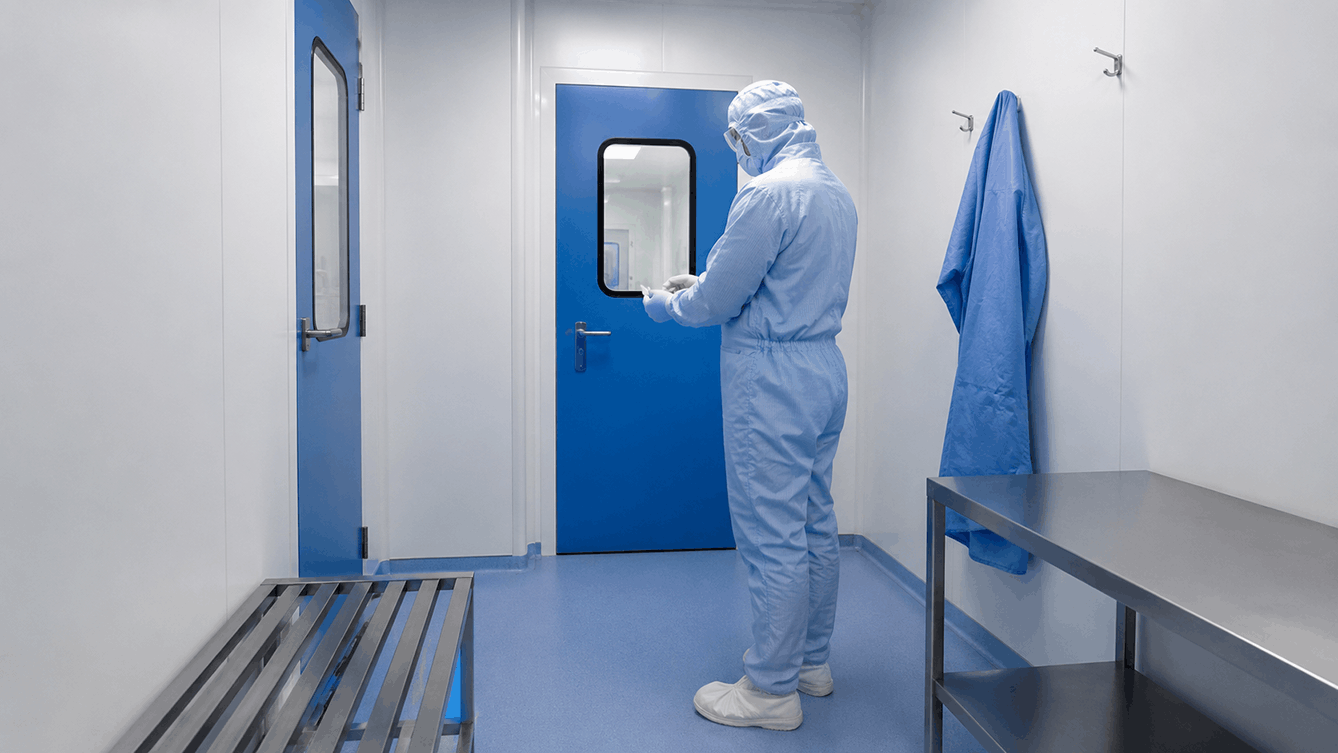
How to Perform a Cleanroom Particle Count Test
- Confirm the protocol. Verify the target class, room state, particle sizes, locations, sample volume and acceptance criteria.
- Review prerequisites. Confirm that construction is complete, cleaning is finished, HVAC is stable and required airflow, pressure and filter checks are available.
- Check the particle counter. Record the instrument identification, calibration due date, flow rate, tubing arrangement and pre-use checks.
- Mark the locations. Use the approved plan so every required point can be identified and repeated.
- Position the probe correctly. Keep the inlet representative of the airflow and avoid unnecessary tubing bends, leaks or obstruction.
- Collect the specified sample. Do not shorten the sampling time because counts appear low or extend only the locations that appear high.
- Record environmental and operational conditions. Note room state, personnel, equipment activity, unusual door events and any deviation from the protocol.
- Review and approve the results. Compare every required result with the acceptance criteria and document any invalid test, investigation, corrective action and retest.
Consistency matters as much as instrument accuracy. Probe position, technician movement, tubing length and door activity can change a reading. A written sequence reduces variation between technicians and makes future cleanroom particle count testing more comparable.
Cleanroom Particle Counter Requirements
The particle counter must be suitable for the particle sizes, concentration range and sampling volume required by the protocol. A current calibration certificate is important, but the operator should also confirm that the instrument identification and calibration status match the report.
Useful pre-test controls include a zero-count or background check where required by the procedure, verification of the programmed size channels, confirmation of the sampling flow rate and inspection of the inlet and tubing. Long or sharply bent tubing can increase particle loss, especially for larger particles, while leaks can make the sample unrepresentative.
The report should not identify the instrument only as “particle counter.” Record the manufacturer, model, serial number, flow rate, calibration reference and calibration due date. If multiple counters are used, results should remain traceable to the specific instrument used at each location.
At-Rest and Operational States
As-built testing evaluates the completed cleanroom with services operating but without production equipment, materials or personnel. It can help verify the basic installation before process equipment and operating variables are introduced.
At-rest testing shows room performance with the cleanroom installation complete and equipment installed and operating as agreed, but without production personnel performing normal work. It is useful for proving that the cleanroom system itself can reach the target class before people and process variables are added. New cleanrooms often use at-rest testing as part of initial acceptance.
Operational testing measures the room during normal use. It is usually more demanding because people, packaging, tools and production movement generate particles. If operational testing is required, the protocol should describe the number of operators, equipment status, cleaning condition and activity level so the result can be repeated.
The selected state must be written into the test report. A room that passes at rest has not automatically demonstrated operational performance. Likewise, operational data cannot be compared fairly when the number of people or process activity changes without explanation.
How to Interpret Particle Count Results
Review the actual count at each required location and particle-size channel against the approved acceptance criterion. Do not hide a high local result by averaging it with low readings from unrelated areas. If repeated samples are allowed, the calculation and decision rule should be defined in the protocol before testing.
A single high reading may indicate a real local contamination source, an unstable room condition or an invalid sample. The correct response is to check the test record, instrument status and room events before deciding whether the result represents failure. Any invalidation should have a documented technical reason; simply disliking the result is not sufficient.
Patterns are often more useful than isolated numbers. High counts across most locations can point to overall filtration, cleaning or HVAC problems. High counts at one door, pass box or operator position suggest a local source. A rising trend across successive tests may justify action even while individual results remain below the formal classification limit.
Common Causes of Failed Tests
Failures may come from filter leakage, weak cleaning, poor gowning, construction dust, unsealed penetrations, bad airflow distribution or excessive operator activity. In new projects, construction residue and late installation work after final cleaning are frequent causes. In operating rooms, process change and maintenance issues are common triggers.
- Filtration: damaged filter media, seal leakage, incorrect installation or an untested terminal housing.
- Airflow: low supply volume, poor distribution, blocked returns, turbulence or a room that has not stabilized.
- Room envelope: open penetrations, damaged seals, ceiling leakage or uncontrolled transfer paths.
- Cleaning and operations: residual dust, unsuitable wipes, poor gowning, excessive movement or material shedding.
- Test method: incorrect locations, insufficient sample volume, contaminated tubing, wrong size channels or an out-of-calibration counter.
The corrective action should be based on evidence, not only repeated cleaning and retesting. Useful troubleshooting may include HEPA integrity testing, airflow visualization, pressure review, cleaning audit and inspection of wall or ceiling penetrations. The final report should document the cause and corrective action, not just the passing retest.
What to Do After a Particle Count Failure
First protect the affected process and preserve the original records. Review the counter status, sampling setup, room state and events that occurred during the test. If the sample is technically valid, investigate the room rather than repeatedly testing until a low value appears.
The investigation should follow the pattern in the data. Localized failures may justify inspection of nearby filters, seals, doors, equipment and operator activity. Widespread failures may require HVAC balancing, filter integrity testing, full-room cleaning or review of recent construction and maintenance work.
After corrective action, allow the room to return to the defined stable condition and repeat the test under the approved protocol. Keep the initial failure, investigation, correction and passing retest together in the final package. That history is more credible than a report containing only the final passing numbers.
Preparation Checklist
Good preparation reduces false failures and makes the result more credible. The room should be cleaned, stabilized and operated in the agreed condition before the particle counter is brought in.
- Confirm the target class, room state and acceptance criteria before testing.
- Approve the sampling locations, particle sizes and sample volume.
- Complete construction cleaning and remove temporary tools and packaging.
- Allow the HVAC system and room conditions to stabilize.
- Verify HEPA filters, pressure and airflow prerequisites.
- Confirm the cleanroom particle counter calibration and programmed channels.
- Control personnel access, gowning and door activity during the test.
- Prepare drawings, room-state records and forms for traceable reporting.
What a Particle Count Test Report Should Include
A useful report allows another reviewer to understand what was tested, reproduce the method and trace every result. It should normally include:
- facility, room name, room number and test date;
- target class, selected particle sizes and room state;
- approved protocol or procedure reference;
- room area, location plan and identification of every sample point;
- sample volume, sample time and counter flow rate;
- particle counter manufacturer, model, serial number and calibration status;
- raw and reported results for each location and size channel;
- acceptance criteria and a clear pass/fail conclusion;
- technician and reviewer identification;
- deviations, invalid samples, investigations, corrective actions and retest results.
Room drawings and location identifiers should match the data table exactly. Ambiguous labels such as “Point 1” are weak when the drawing does not show where Point 1 was located.
Testing Frequency and Retesting Triggers
There is no single testing interval that fits every cleanroom. Frequency depends on the applicable industry requirements, target class, process risk, monitoring history and quality system. The site should define and justify its classification and monitoring schedule rather than rely on a generic annual statement.
Additional particle count testing is commonly considered after HVAC modification, filter replacement, room-layout change, major maintenance, abnormal environmental monitoring, loss of pressure control, contamination events or extended shutdown. The scope can range from a targeted investigation to full reclassification depending on the change and risk assessment.
Hurricane Techs Recommendation
Plan particle count testing with the full validation package. Particle data is strongest when it is supported by airflow, pressure and HEPA integrity evidence instead of standing alone as a simple pass/fail table.
Hurricane Techs can support cleanroom validation, maintenance and recertification and HEPA filter review for cleanroom owners who need reliable classification and retesting support.
FAQ
How often should cleanrooms be particle tested?
Frequency depends on industry requirements, room class, process risk, monitoring history and the site quality system. Retesting is also common after modification, filter replacement, major maintenance or abnormal monitoring results.
What causes high particle counts?
Common causes include people, poor cleaning, filter leakage, weak or unstable airflow, construction residue, open penetrations, material shedding and an incorrect test setup.
Can HEPA filter leakage fail a particle test?
Yes. HEPA leakage can increase local particle concentration and should be checked during troubleshooting. However, a passing particle count does not replace an installed HEPA integrity test because the two tests prove different things.
What is the difference between particle count testing and HEPA integrity testing?
Particle count testing measures airborne particle concentration in the room. HEPA integrity testing challenges the installed filter system to locate leakage through the media, frame, seal or housing. Both may be required for cleanroom qualification.
What particle sizes are used for cleanroom classification?
The selected sizes depend on the target class and protocol. ISO classification commonly uses threshold sizes within the applicable range from 0.1 µm to 5 µm. Many projects focus on 0.5 µm and may include additional sizes when required by the class, process or regulation.
Can a cleanroom be tested during production?
Yes, when operational classification or monitoring is required. The protocol should define personnel, equipment, material movement and process activity so the operating condition is representative and repeatable.
Does one high particle count mean the room fails?
A high result must be evaluated under the approved protocol. The team should determine whether the sample was valid and whether the location exceeded its acceptance criterion. A valid failure should be investigated and documented rather than averaged away or repeatedly sampled without justification.


