
HEPA filter integrity testing verifies that an installed filter system has no unacceptable local leakage through the media, frame, gasket, gel seal, housing or surrounding interface. Commonly called a PAO test or DOP test, it is an in-situ aerosol challenge performed after installation. It answers a different question from the factory efficiency certificate: not only whether the filter element was manufactured correctly, but whether the complete installed assembly still provides the intended barrier.
A cleanroom may have certified filters and still fail at handover if a filter was damaged during transport, seated unevenly, installed in a leaking housing or made impossible to scan completely. For that reason, the test protocol should define access, operating condition, upstream challenge, scan coverage, acceptance criteria, repair rules and final records before ceiling closure—not after commissioning has already started.
HEPA Filter Integrity Testing at a Glance
| QuestionWhat the test should establishWhat it does not establish alone | ||
| What is tested? | Installed media, frame, gasket or gel seal, housing and perimeter interfaces | The factory efficiency of an uninstalled filter batch |
| How is it challenged? | A measurable upstream aerosol is introduced and local downstream penetration is scanned | Room cleanliness based only on ambient particle counts |
| What defects can be found? | Media damage, seal bypass, poor seating, frame or housing leakage and installation defects | Every possible HVAC, airflow or operational problem |
| When is it performed? | At installation and at risk-based intervals or after events that may affect integrity | A universal schedule for every industry and room |
| What should be delivered? | Traceable filter schedule, protocol, instrument records, challenge data, scan results, deviations and retest evidence | A one-line statement saying “DOP test passed” |
What HEPA Filter Integrity Testing Proves
The integrity test is an installation-level test. It challenges the upstream side of a terminal filter or filter system and looks for localized penetration downstream. A complete scan covers the filter face and the perimeter where bypass can occur, including the frame, gasket or gel seal and housing interface. The objective is to find a local leak that a room-average measurement could miss.
This distinction matters because a factory certificate does not cover shipping, storage, site handling, ceiling installation or final gasket compression. Even an H13 or H14 HEPA filter with a valid individual test report can be compromised after leaving the manufacturer. Installed testing provides evidence about the condition the owner will actually operate.
Integrity testing also differs from cleanroom particle count classification. Particle classification asks whether airborne concentrations meet the selected ISO class under an agreed room state. Integrity testing asks whether the installed filter assembly contains a local leakage path. A robust handover program may require both, together with airflow, pressure, recovery and other tests relevant to the process.
Standards and Protocol Basis
ISO 14644-3:2019 provides cleanroom test methods for different airflow types and for as-built, at-rest and operational states. The project protocol should identify the applicable method, test condition and customer requirements rather than using “DOP test included” as the entire specification.
For aseptic pharmaceutical facilities, the FDA aseptic-processing guidance explains that leak testing should detect integrity breaches around sealing gaskets, frames and filter media at installation and at suitable intervals afterward. Other industries and quality systems can require different scopes or frequencies, so acceptance criteria must come from the governing standard, owner procedure and risk assessment.
The test provider should state the reference procedure and equipment being used. Photometer-based aerosol scanning and discrete-particle-counter methods are not interchangeable by assumption; the challenge concentration, instrument response, scan method and acceptance calculation must be appropriate for the chosen procedure.
DOP and PAO Aerosol Basics
“DOP test” remains common market language, but many current protocols use polyalphaolefin (PAO) as the challenge aerosol. DOP and PAO describe the aerosol material, not the complete test method. Simply changing the aerosol name does not prove that the challenge was stable, the instrument was suitable or the full filter perimeter was scanned.
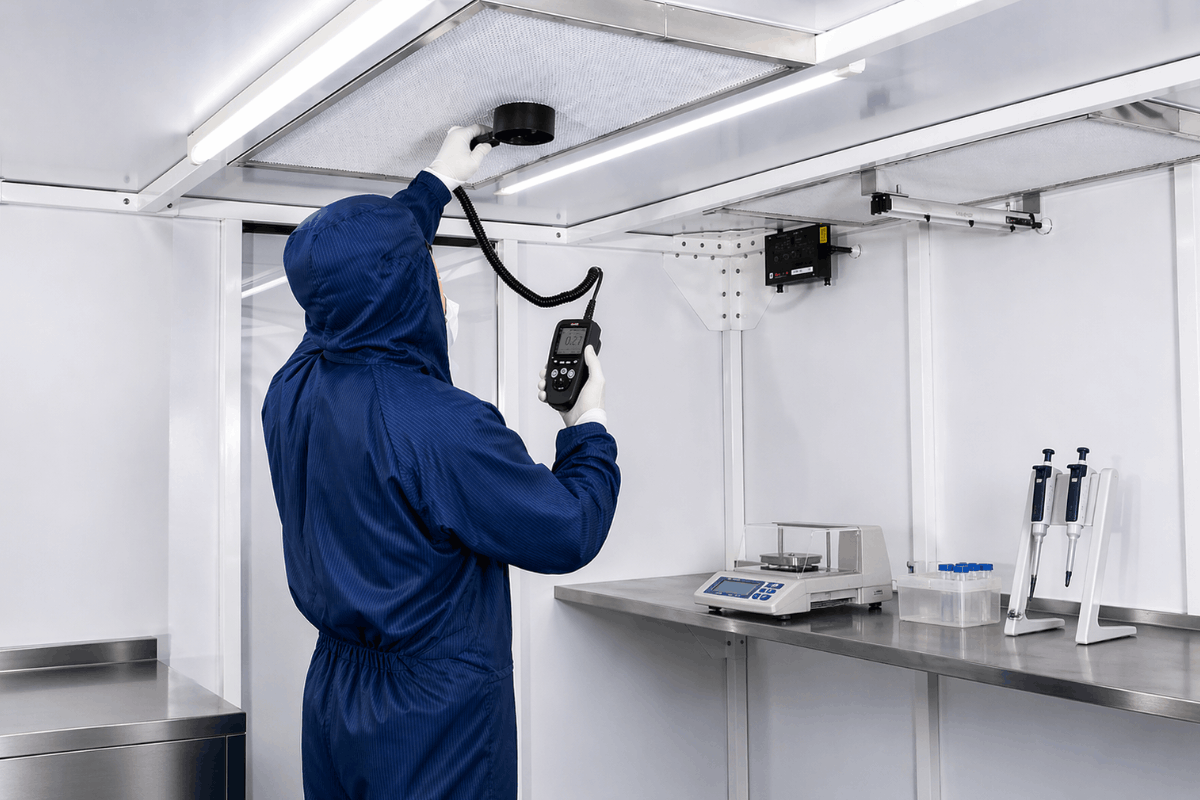
A defensible method needs an upstream concentration that is measurable and sufficiently mixed at the filter. The technician then scans downstream using the probe position, traverse rate and overlap required by the approved procedure. If the upstream challenge varies significantly, the scan is too fast, the probe is held too far away or access is obstructed, a local defect can be missed.
Step-by-Step Installed HEPA Leak Test
- Confirm the test boundary. Identify every filter by room, terminal location, size, grade and unique ID. Agree whether return, exhaust or special-process filters are included.
- Establish the operating condition. Record the HVAC state, design airflow, room state and any safety controls required for aerosol introduction.
- Introduce and mix the challenge. Select a safe injection point that gives a representative upstream concentration across the filter rather than a concentrated plume in one corner.
- Measure the upstream challenge. Confirm that the concentration is within the method and instrument range and remains suitable while scanning is performed.
- Scan the downstream side. Cover the media in overlapping passes and inspect the full frame, seal and housing perimeter. A single spot reading is not a complete scan.
- Mark and investigate any leak. Record the exact location and determine whether the cause is media damage, poor seating, seal failure or a housing defect.
- Repair or replace under an approved rule. The protocol should define which repairs are permitted and when replacement is mandatory.
- Retest after correction. A repair is not complete until the affected area—and any required surrounding scope—passes the repeat test and the history is documented.
Efficiency Grade, Factory Test and Installed Integrity
| EvidenceQuestion answeredTypical limitation | ||
| Filter efficiency or individual factory report | Did the filter element meet its specified classification when manufactured and tested? | Does not cover transport, site installation or housing bypass |
| Installed HEPA integrity test | Does the installed media, frame, seal and housing have unacceptable local leakage? | Does not classify the room or prove airflow distribution |
| Room particle count test | Does the room meet its airborne particle class under the agreed state? | May not identify the exact location or cause of a local defect |
| Airflow and pressure tests | Does the HVAC system deliver the intended volume, direction and room relationship? | Does not replace filter leak scanning |
These records should support each other. Specifying H14 instead of H13 cannot compensate for a leaking gasket, blocked scan access or unstable airflow. Likewise, a passing integrity test does not prove that the room has enough airflow or that operators and equipment will remain within the particle limit during production.
Common HEPA Leakage Causes
Leak locations often reveal where the project process failed. Media damage can occur during transport, unpacking or installation. Gasket leakage can result from uneven compression, an unsuitable frame, debris on the sealing surface or incorrect clamping. Gel-seal systems can be affected by a damaged knife edge, inadequate gel condition or poor seating. Housing and ceiling interfaces may leak because of fabrication defects, loose fasteners, failed sealant or movement around service penetrations.
Repeated failure in the same location should not be treated as an isolated filter problem. It can indicate a distorted housing, an inaccessible clamping system, ceiling movement, poor replacement access or a design that makes correct installation difficult. The investigation should distinguish a replaceable filter defect from a system defect that will recur.
Seven Records Required for Cleanroom Handover
The final package should make the test traceable and repeatable. Buyers should request at least the following:
- A filter schedule connecting every result to a room, terminal location and unique filter ID.
- The approved procedure, governing reference, room state, airflow condition and acceptance criteria.
- Identification and calibration status for the aerosol generator, photometer or particle-counting equipment and related instruments.
- The aerosol type, injection location, measured upstream challenge and evidence that it remained suitable during scanning.
- A record showing complete scan coverage of the media, frame, seal and housing perimeter.
- A deviation log with leak location, diagnosis, permitted repair or replacement and repeat-test result.
- An approved final report linked to commissioning, qualification and the preventive-maintenance or recertification plan.
A report that only lists “pass” against a room name is weak evidence. The owner should be able to identify which physical filter was tested, which procedure was followed, whether repairs occurred and which final result established acceptance.
When Should HEPA Filters Be Retested?
There is no single interval that applies to every cleanroom. The schedule should follow the applicable regulation, process risk, owner quality system and monitoring history. Integrity testing is commonly considered at initial installation, after replacement or reseating, and periodically during operation where the governing program requires it.
Additional testing may be justified after ceiling or HVAC work, building vibration or impact, water intrusion, an unexplained particle excursion, loss of airflow, a sterility or media-fill investigation, or any event that could disturb the filter, housing or seal. A change-control assessment should state whether the event affects only one terminal filter or a broader area.
Routine replacement should not be based on calendar age alone. Pressure drop, airflow capacity, integrity results, contamination loading, process risk and manufacturer limits should be reviewed together. See our guide to cleanroom HEPA filter replacement frequency for maintenance planning.
Design the Cleanroom for Testability
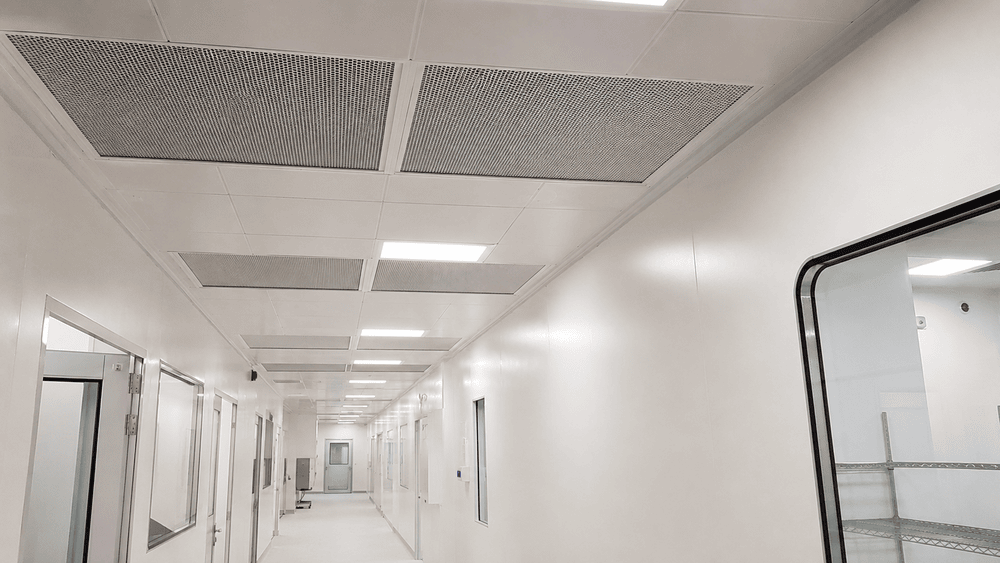
Integrity testing becomes expensive and uncertain when it is considered after equipment and ceilings are fixed. Design reviews should confirm upstream aerosol injection points, representative sampling access, downstream scan clearance, safe technician access, terminal identification and a practical way to remove and replace filters without damaging adjacent finishes.
Lights, sprinkler heads, services, process equipment and ceiling support members should not block the probe path around the filter face and perimeter. For hard-to-access terminal units, the owner and supplier should agree on the test method before procurement. “Test included” has little value if the installation cannot be scanned completely.
Hurricane Techs Recommendation
Define HEPA integrity testing in the URS, validation plan and supplier contract before the cleanroom ceiling is finalized. Separate factory filter documentation, installed leak testing, airflow verification and room particle classification into distinct deliverables with clear responsibility and acceptance criteria.
Hurricane Techs supports cleanroom validation testing, HEPA and ULPA filter supply and maintenance and recertification. For a useful test proposal, provide the filter schedule, room layout, filter grade and housing type, airflow condition, governing procedure, required room state and documentation format.
FAQ
What is HEPA filter integrity testing?
It is an in-situ test that challenges an installed filter upstream and scans downstream to detect unacceptable local leakage through the media, frame, seal, housing or perimeter interface.
Is a PAO test the same as a DOP test?
The terms are often used for the same general aerosol leak-testing purpose, but PAO is commonly used in current protocols while DOP is legacy market terminology. The approved method, challenge, instrument, scan coverage and acceptance criteria matter more than the shorthand name.
Is a factory HEPA certificate enough?
No. A factory report does not cover shipping damage, installation, gasket compression, housing leakage or final site conditions. Installed integrity testing addresses those risks.
Does a passing PAO test prove the cleanroom class?
No. The PAO or DOP integrity test checks local filter-system leakage. ISO cleanroom classification requires a separate airborne particle-count test under a defined sampling plan and room state.
How often should HEPA integrity testing be performed?
Frequency depends on the applicable standard, industry, process risk and quality system. Retesting is also commonly considered after filter replacement, HVAC or ceiling work, unexplained excursions or events that may disturb the filter assembly.
What happens if a HEPA filter fails the test?
The leak should be located and investigated. Any permitted repair or replacement must be documented and followed by a repeat test under the approved protocol before acceptance.


