
Laminar flow hoods and clean benches provide localized clean air for products, samples or small process steps. The terms are sometimes used loosely, so buyers should confirm airflow direction, protection target, filter grade and application limits before ordering.
The most important question is what needs protection. Some equipment protects only the product, not the operator. Other equipment, such as biosafety cabinets, is designed for personnel and environmental protection under different rules. Confusing these categories can create real safety and quality risks.
This guide compares laminar flow hoods and clean benches, explains horizontal and vertical airflow, and outlines the clean bench testing, maintenance and procurement information needed for reliable operation.
Laminar Flow Hood vs Clean Bench at a Glance
- Clean bench: normally provides HEPA-filtered airflow across a work zone for product protection during non-hazardous work.
- Laminar flow hood: a commonly used commercial term for localized unidirectional-airflow equipment; the exact airflow path and protection function must be confirmed.
- Horizontal flow: air generally travels from the rear filter toward the operator.
- Vertical flow: air generally moves downward over the work surface before leaving or returning through the cabinet.
- Important limitation: a standard clean bench should not be assumed to protect personnel, the environment or hazardous materials.
- Key acceptance checks: filter integrity, airflow velocity and uniformity, airflow visualization, particle cleanliness and alarm or control operation where applicable.
The labels “laminar hood,” “clean air bench,” “clean bench” and “laminar flow bench” may describe similar-looking equipment from different suppliers. The name alone does not establish performance. Buyers should compare the airflow diagram, intended use, test criteria and documented clean zone.
Terminology and Practical Difference
A clean bench usually provides HEPA-filtered air across a work surface to protect the product from particles. It is commonly used for electronics, optics, sample preparation and non-hazardous clean handling. It should not be used for hazardous biological or chemical work unless specifically designed and approved for that purpose.
A laminar flow hood may describe horizontal or vertical unidirectional airflow equipment. In practice, buyers should look beyond the name and check the airflow diagram. The airflow direction determines where particles move and whether the operator, product or environment is protected.
The term “laminar flow bench” is also commonly used as an alternative to clean bench. Searches for laminar flow benches may lead to horizontal-flow or vertical-flow models, so the buyer should compare the protection function and technical specification rather than assume that every product with that name operates in the same way.
“Laminar flow” is also used casually when “unidirectional airflow” is more precise. Real equipment contains disturbances from the work surface, objects, operator movement and cabinet geometry. The design goal is a stable clean-air path through the critical work zone, not a perfect theoretical flow pattern at every point.
ISO 14644-7 addresses separative devices such as clean air hoods, gloveboxes, isolators and mini-environments. Project requirements still need to define the process, protection target and acceptance tests agreed between buyer and supplier.
Horizontal vs Vertical Airflow
Horizontal airflow moves clean air from the back of the work zone toward the operator. It can provide good product protection for non-hazardous work, but it may blow particles or vapors toward the user. This makes application review essential.
Horizontal clean benches often provide a direct path from the rear HEPA filter across the product. Tall objects, stacked materials or excessive equipment can block that path and create downstream turbulence. The working arrangement should therefore be considered when selecting cabinet depth and filter coverage.
Vertical airflow moves clean air downward over the work surface and then out through the front or return path. It may be preferred when the work surface layout or product shape benefits from downward flow. The correct choice depends on process, object size, operator posture and contamination source.
Vertical units can provide more flexibility for large objects, but lighting, internal components and operator arms can still disturb airflow. A vertical-flow label does not automatically mean personnel containment. The actual inlet, outlet and return-air arrangement must be reviewed.
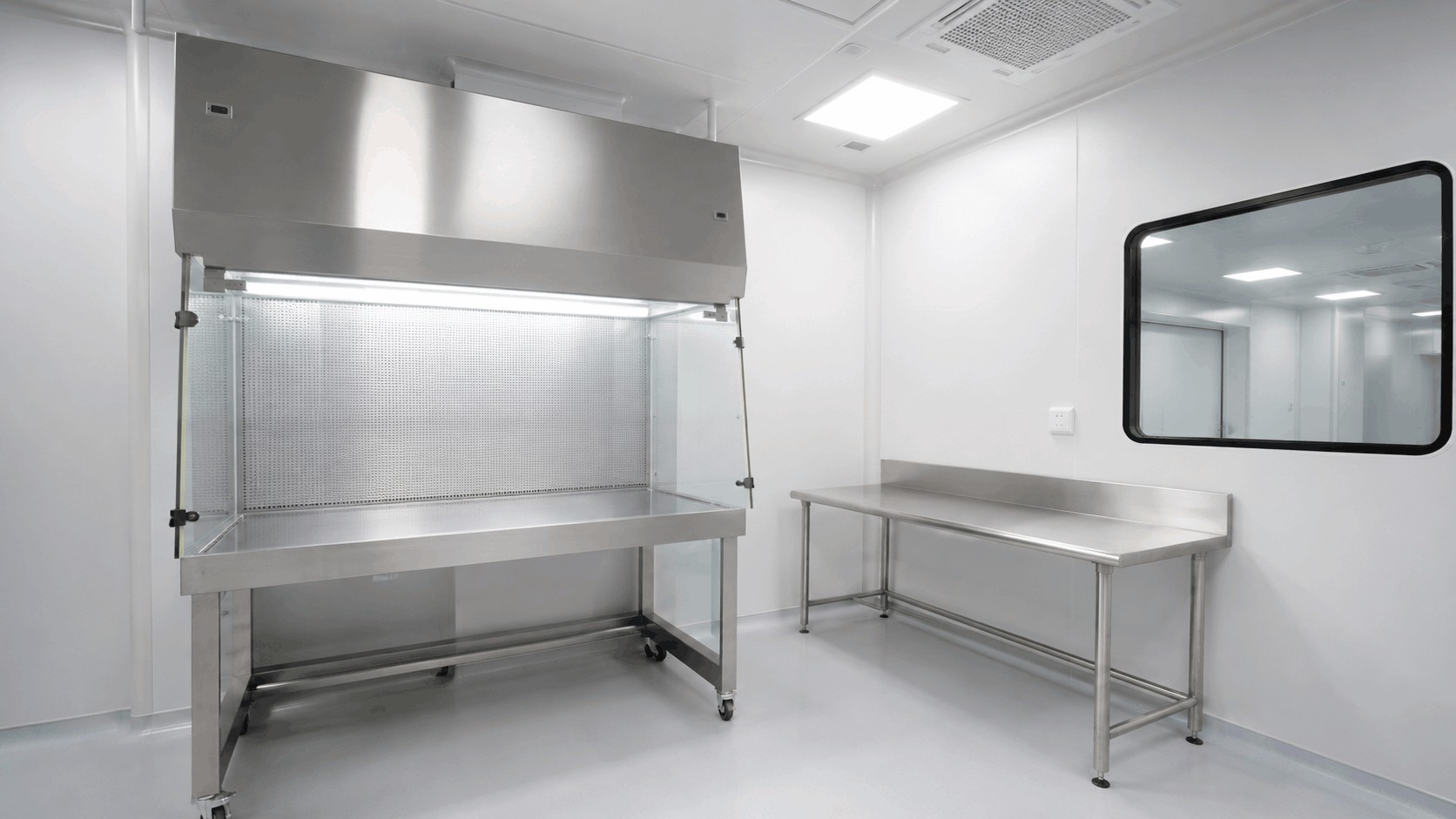
Product Protection vs Personnel Protection
Many clean benches protect the product but do not protect the operator. If the process involves harmful powders, biological materials, solvents or active pharmaceutical ingredients, a standard clean bench may be the wrong equipment. The safety requirement must be reviewed before purchase.
For product protection, airflow uniformity, HEPA filter integrity, work surface cleanability and operating discipline are important. Operators should avoid blocking airflow with hands, tools or packaging. Even a good bench can perform poorly if the work zone is crowded or used incorrectly.
Personnel and environmental protection require equipment specifically designed, tested and approved for that hazard. A front sash, fan and HEPA filter do not by themselves make a unit a biosafety cabinet or containment enclosure. The risk assessment should consider aerosols, vapors, powders, organisms and any material that could harm the operator or surrounding room.
Clean Bench vs Biosafety Cabinet and Fume Hood
A clean bench directs clean air over the work to reduce product contamination. Depending on the airflow arrangement, air may leave the work zone toward the operator or room. It is intended for non-hazardous processes unless the manufacturer states otherwise.
A biosafety cabinet is designed around biological containment and defined personnel, product and environmental protection functions. Its airflow paths, inflow, downflow, exhaust arrangement and certification requirements differ from those of a standard clean bench.
A chemical fume hood is designed to capture and exhaust hazardous vapors. It does not normally provide a particle-controlled product zone. Buyers should not substitute one category for another simply because the enclosures look similar.
Applications and Limitations
Clean benches are often used for precision assembly, small component handling, laboratory preparation, optical inspection and electronics work. They are useful when the room itself does not need to be a higher class but a local clean zone is required.
Other potential applications include non-hazardous media preparation, inspection, packaging, sensor assembly and handling of cleaned components. Suitability depends on particle sensitivity, work practices, material generation and the required cleanliness at the product location.
Limitations should be clear in the SOP. The bench does not replace room cleanliness, gowning or material cleaning. It also does not solve cross-contamination if incompatible materials are handled in the same workspace without procedure control.
The surrounding room matters because operators, doors, supply diffusers and nearby equipment can affect the bench opening. A clean bench installed in a dusty, turbulent or congested location may require more cleaning and may not maintain the expected local conditions during real work.

HEPA Filtration and Airflow Design
The HEPA filter removes airborne particles from the supply air before it enters the work zone. Filter grade is important, but installed performance also depends on frame sealing, housing design, fan capacity and the ability to scan or test the installed filter system.
A higher filter grade is not automatically a better selection if the fan system cannot maintain the required airflow through the added resistance. Buyers should review initial and final pressure drop, airflow control range and how the unit indicates filter loading.
Filter coverage should support the intended work zone. Internal lights, shelves, service outlets and structural components should not create avoidable dead zones. Airflow visualization during qualification can show whether equipment and normal hand positions disrupt the clean-air path.
Where speed control is provided, access should be managed so operators cannot unintentionally change validated settings. The unit should return to a controlled condition after power interruption, filter replacement or maintenance.
What Clean Bench Testing Should Cover
Clean bench testing should confirm the performance claimed in the user requirement specification and supplier documents. ISO 14644-3 provides test methods for cleanrooms and clean zones, while the exact bench protocol should reflect equipment design, application and applicable quality requirements.
HEPA Filter Integrity
Installed filter integrity testing checks for leakage through the filter media, frame, seal and housing. A factory filter certificate does not prove that the filter remained undamaged during transport and installation or that the installed seal is leak-free.
Airflow Velocity and Uniformity
Measurements should demonstrate that the unit delivers the specified airflow across the defined work zone. The protocol should identify the measurement grid, instrument, operating setting and acceptance range. One reading at the center is not enough to demonstrate uniform performance.
Airflow Visualization
Airflow visualization helps reveal turbulence, reverse flow, dead zones and disruption caused by equipment or operator technique. The study should use a method suitable for the process and should document the bench configuration during the test.
Particle Cleanliness
Particle measurements can demonstrate the airborne cleanliness achieved in the defined work zone under an agreed condition. The report should state sampling locations, particle sizes, sample volume, operating state and acceptance criterion. The result should not be described as the classification of the entire room unless the room itself was tested under an appropriate protocol.
Controls and Alarms
Where fitted, fan controls, airflow indicators, pressure displays, alarms, lighting, UV controls and interlocks should be checked against the approved functional requirements. Alarm setpoints should be meaningful and protected from unauthorized changes.
Factory Testing, Site Acceptance and Qualification
Factory testing can confirm dimensions, materials, basic airflow and filter installation before shipment. It is useful for finding fabrication issues early, especially for customized benches. The factory report should identify the exact unit by model and serial number.
Site acceptance confirms that transport, installation and connection have not changed performance. Testing should be completed in the installed location because room airflow, nearby equipment and utility connections may affect operation.
Qualification may include installation checks, operating tests and performance testing under the user’s intended condition. The scope should be agreed before purchase so access ports, filter scanning, instruments and documentation are available when the unit arrives.
How Often Should a Clean Bench Be Tested?
There is no single interval that applies to every clean bench. The site should define frequency from process risk, quality-system requirements, equipment use, performance history and applicable regulation.
Additional testing should be considered after filter replacement, relocation, fan or controller repair, changes to the work-zone configuration, unexplained particle results, damage, extended shutdown or any event that could affect airflow or filter integrity.
Routine checks between formal qualifications may include cleaning inspection, airflow or pressure indication, alarm status and review of unusual noise or vibration. These operator checks do not replace periodic technical performance testing.
Work-Zone Design and Construction
The work surface should be smooth, cleanable and compatible with process chemicals. Stainless steel is common, but the required grade and finish depend on the application. Joints, fasteners and service penetrations should avoid unnecessary particle traps.
Useful design options may include front sash arrangements, height-adjustable stands, electrical outlets, gas or vacuum services, lighting, monitoring displays and mobile bases. Every added feature should be reviewed for airflow obstruction, cleaning access and maintenance.
Cabinet dimensions should be based on the real product, tools and operator movements. A bench that is too small becomes crowded and disrupts airflow. An oversized unit may add unnecessary footprint, filter area, fan energy and replacement cost.
Good Operating Practices
- Allow the unit to reach its defined operating condition before critical work.
- Clean the work surface and materials according to the approved procedure.
- Keep the filter face, perforations and return paths unobstructed.
- Arrange clean and used materials to reduce cross-contamination.
- Work far enough inside the controlled zone to avoid edge disturbance.
- Move hands and materials slowly to limit turbulence.
- Do not use open flames, powders, solvents or biological hazards unless the equipment is specifically designed and approved for them.
- Record alarms, unusual airflow and maintenance observations.
Operator training should explain why each rule matters. A clean bench can pass qualification and still provide poor protection when objects block the clean-air path or contaminated materials are introduced without cleaning.
Cleaning, Maintenance and Filter Replacement
Cleaning procedures should define approved agents, contact time where relevant, wipe direction and treatment of corners, perforations and service fittings. Liquids should not enter filters, fans, electrical components or airflow openings.
Maintenance access should be considered before purchase. Technicians need safe access to filters, prefilters, fans, sensors, lights and control components without damaging seals or contaminating the work zone.
HEPA filters should not be replaced only because of calendar age. Decisions can consider pressure drop, airflow performance, integrity-test results, contamination events and manufacturer guidance. After replacement, the installed system should be retested before critical use.
Selection Checklist
Select the equipment by protection target and process risk. A clear checklist helps avoid buying a clean-air device that looks correct but does not fit the work.
- Confirm whether product, personnel or environment needs protection.
- Choose horizontal or vertical airflow based on the process.
- Check HEPA grade, airflow velocity and work zone size.
- Plan cleaning, filter replacement and performance testing.
- Define the required particle cleanliness and operating state.
- Confirm materials, dimensions, utilities and ergonomic requirements.
- Specify alarms, displays, controls and access permissions.
- Agree factory tests, site tests, documents and training before ordering.
What to Include in a Clean Bench RFQ
- process description and materials handled;
- required protection target and explicit prohibited uses;
- horizontal or vertical airflow configuration;
- required work-zone dimensions and cabinet footprint;
- HEPA filter grade, access and integrity-test requirements;
- airflow performance and particle-cleanliness acceptance criteria;
- work-surface and cabinet materials;
- electrical, lighting, outlet and utility requirements;
- controls, alarms, displays and communication outputs;
- factory testing, site acceptance, qualification and calibration documents;
- spare parts, filter replacement method, warranty and training.
Ask suppliers to state deviations and exclusions clearly. Similar-looking benches may differ substantially in filter coverage, fan reserve, testing access, controls and documentation.
Common Buying Mistakes
- Choosing equipment by catalog name without reviewing the airflow diagram.
- Using a product-protection bench for hazardous work.
- Specifying only HEPA grade and ignoring installed integrity and fan capacity.
- Using one center-point airflow reading as proof of uniformity.
- Failing to define the clean work zone and particle-test locations.
- Adding large equipment after selection without checking airflow obstruction.
- Omitting site qualification, training and filter-replacement access.
Hurricane Techs Recommendation
Define the use case before selecting a laminar flow hood or clean bench. The airflow direction, filter system and work surface should support the actual task instead of being chosen only from a catalog image.
Hurricane Techs supplies laminar flow hoods and clean benches, HEPA filters and cleanroom consulting for buyers who need local clean-air equipment integrated with room operation.
FAQ
Is a clean bench the same as a biosafety cabinet?
No. A standard clean bench primarily protects the product but may not protect personnel or the environment. A biosafety cabinet has a different containment function and certification basis.
Does a laminar flow hood protect users?
Only if it is specifically designed for that purpose. Confirm the equipment type, airflow path, exhaust arrangement and approved application before use.
What HEPA grade is used in clean benches?
The grade depends on the manufacturer and application. Buyers should review filter grade together with installed integrity, airflow, pressure drop and test documentation.
What is the difference between horizontal and vertical clean benches?
A horizontal bench generally moves filtered air from the rear toward the operator. A vertical bench generally moves air downward over the work surface. Product shape, operator position and contamination sources determine which arrangement is more suitable.
What tests are required for a clean bench?
The agreed protocol commonly addresses HEPA integrity, airflow velocity and uniformity, airflow visualization, particle cleanliness and operation of controls or alarms. Requirements should match the application and supplier claims.
Can a clean bench be used for biological samples?
Only when the samples are non-hazardous and the risk assessment permits it. Work requiring biological containment should use equipment designed and certified for that protection function.
Does a clean bench replace a cleanroom?
No. It can create a local clean zone for a defined task, but the surrounding room, operators, materials, cleaning and process controls still affect performance.
When should the HEPA filter be replaced?
Replacement should consider airflow, pressure drop, integrity results, contamination events and manufacturer guidance rather than age alone. The unit should be retested after filter replacement.


