
In cleanroom design, doors are often underestimated.
A cleanroom may have high-efficiency HEPA filtration, well-selected wall panels, proper flooring, and a carefully designed HVAC system. But every time a door opens, the cleanroom is temporarily connected to a less controlled environment. In that short moment, particles, microorganisms, chemical fumes, humidity, and pressure disturbances may move across the boundary.
This is why cleanroom airlock design is not a small architectural detail. It is an important part of contamination control.
For pharmaceutical cleanrooms, laboratory cleanrooms, electronics cleanrooms, food cleanrooms, and healthcare environments, a well-designed airlock helps reduce particle migration, stabilize pressure relationships, and protect critical production areas.
As discussed in Wei Sun’s ASHRAE Journal article “Cleanroom Airlock Performance and Beyond,” an airlock is not simply a small transition room. It is a contamination migration barrier between a controlled environment and a less controlled adjacent area. This is why airlock design should be evaluated by airflow direction, pressure relationship, door operation, and the way people or materials actually move through the cleanroom.
What Is a Cleanroom Airlock?
A cleanroom airlock is a transitional space between two areas with different cleanliness levels or pressure requirements. It usually includes two doors arranged in series. These doors are typically interlocked so that they cannot be opened at the same time during normal operation.
The purpose is simple: reduce direct air exchange between the cleanroom and the surrounding corridor or adjacent room.
Depending on the application, an airlock may be used for:
- Personnel entry and exit
- Material transfer
- Gowning transition
- Pressure cascade control
- Microbial contamination control
- Chemical fume containment
- Protection of sterile or sensitive processes
In GMP cleanrooms and ISO-classified cleanrooms, airlocks are especially important because contamination control depends not only on filtration, but also on how people, materials, and air move through the facility.
Why Door Opening Is a Critical Contamination Risk
When a cleanroom door is closed, air leakage usually occurs through small cracks and gaps. If the cleanroom has a correct pressure differential, this leakage can be controlled.
But when the door opens, the situation changes immediately.
The opening becomes much larger than normal leakage paths. Pressure differential may drop suddenly. Human movement creates turbulence. The door swing itself can move air like a piston. The cleanroom side may experience a short surge of particles from the corridor or adjacent area.
One of the most important engineering insights from ASHRAE’s discussion is that door-open conditions can be much more critical than door-closed conditions. A cleanroom may maintain the correct pressure differential when the door is closed, but when the door opens, leakage area suddenly increases, pressure balance is disturbed, and particle migration can occur within seconds.
This is why a cleanroom that looks stable on a pressure gauge may still experience contamination during daily operation.
In real facilities, doors may open dozens or hundreds of times per day. Even if each opening lasts only a few seconds, the accumulated contamination risk can become significant.
Static and Dynamic Contamination Are Both Important
Many cleanroom designs focus heavily on static conditions: room pressure when doors are closed, air change rate, HEPA filter coverage, and particle counts during at-rest testing.
These are essential. But they are not enough.
Dynamic contamination during door operation must also be considered. A cleanroom may pass at-rest testing but still face contamination problems during production if personnel movement, material transfer, or door operation is poorly controlled.
Research discussed in ASHRAE Journal suggests that particle migration during door-in-operation conditions can be far higher than under door-closed conditions. This finding is important because cleanroom risk is not only determined by stable pressure readings, but also by repeated short-duration contamination events during actual operation.
This is especially important for:
- Pharmaceutical cleanrooms
- Sterile filling areas
- Sampling and dispensing rooms
- Laboratories
- Operating rooms
- Electronics cleanrooms
- High-value precision manufacturing areas
A good cleanroom design should ask not only “What is the pressure when the door is closed?” but also “What happens when people and materials actually move through the door?”
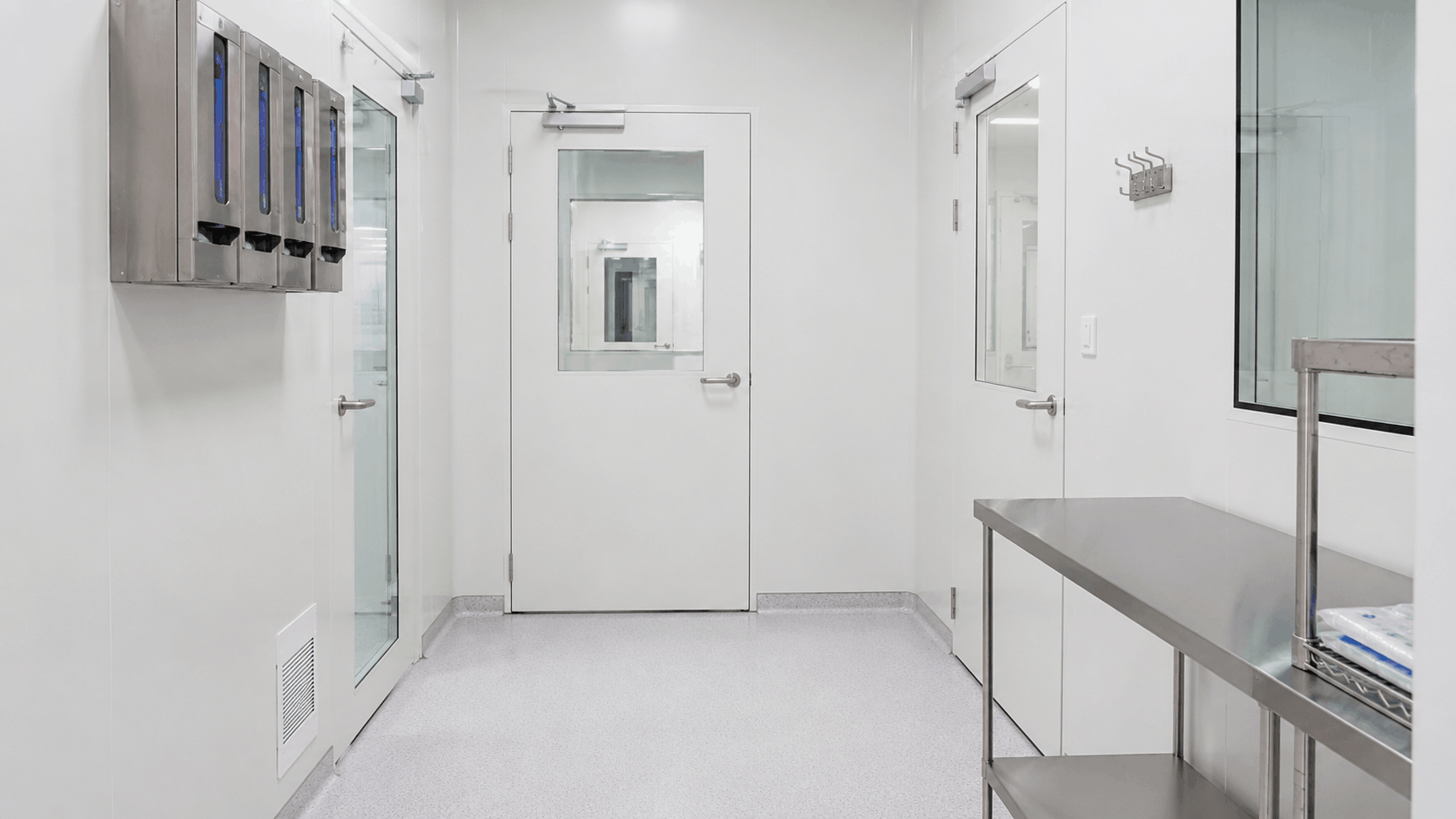
Common Types of Cleanroom Airlocks
Different airlock types create different airflow and pressure relationships. The correct selection depends on whether the goal is to protect the cleanroom, protect the surrounding environment, or control both directions of contamination risk.
ASHRAE Journal’s discussion of airlock performance compares common arrangements such as cascading, bubble, sink, and dual-compartment airlocks. In practical cleanroom projects, the best choice depends on whether the design goal is product protection, operator protection, containment, or a combination of these priorities.
Cascading Airlock
A cascading airlock uses a step-by-step pressure relationship, usually moving from higher pressure in the cleanroom toward lower pressure in adjacent spaces. This is common when the goal is to protect the cleanroom from outside contamination.
For many standard cleanroom applications, cascading pressure design is practical and easy to understand.
Bubble Airlock
A bubble airlock is maintained at a higher pressure than both adjacent areas. Air flows outward from the airlock to both sides. This can help prevent contaminants from entering the airlock from either side.
Bubble airlocks are often considered where the airlock itself needs to remain cleaner than surrounding areas.
Sink Airlock
A sink airlock is maintained at lower pressure than both adjacent areas. Air flows into the airlock from both sides. This can help contain hazardous materials, odors, chemical fumes, or biological risks within the airlock.
Sink airlocks are useful in containment-focused applications but may not be the best choice when the main goal is protecting a cleanroom from outside particles.
Dual-Compartment Airlock
A dual-compartment airlock uses two connected airlock spaces instead of one. It provides an additional barrier and can significantly improve contamination control when designed correctly.
For high-risk cleanroom applications, dual-compartment airlocks often provide stronger overall protection than a simple single airlock.
Pressure Differential: Important, But Not the Only Answer
Cleanroom designers often use pressure differential to control airflow direction. Typical cleanroom pressure steps may be around 5 Pa, 10 Pa, or 15 Pa depending on the application and design standard.
Pressure differential is important, but it should not be treated as a complete solution.
Increasing pressure differential does not always produce a proportional improvement in airlock performance. Once a reasonable pressure step is achieved, other factors may become more important, such as door opening time, airlock ACH, interlock delay, door leakage, and traffic frequency.
In practical design, pressure differential should be balanced with:
- Door construction and sealing
- Cleanroom envelope tightness
- Supply and return air balance
- Airlock volume
- Door operation frequency
- Personnel behavior
- Emergency egress requirements
A cleanroom is not protected by pressure alone. It is protected by the complete system.
Required Time Delay Between Doors
One of the most important airlock design details is the time delay between door operations.
If the first door opens and then closes, the air inside the airlock may contain particles or contaminants from the less clean side. If the second door opens immediately, those contaminants may migrate into the cleanroom.
A time delay allows filtered supply air to dilute or replace the air inside the airlock before the second door opens.
ASHRAE Journal notes that two quantified approaches can help reduce contaminant migration through an airlock: increasing the air change rate inside the airlock for faster dilution, or waiting longer before the next door operation. This is why the required time delay between sequential door operations should be specified during airlock design, not decided casually after installation.
For example, an airlock with a high air change rate can recover faster than one with a low air change rate. A higher ACH may allow a shorter required time delay, while a lower ACH may require a longer delay.
This is why airlock design should not only specify “two interlocked doors.” It should also define:
- Airlock supply airflow
- Return or exhaust strategy
- Pressure relationship
- Door interlock logic
- Time delay between doors
- Emergency override behavior
- Validation or smoke test requirements
For GMP and high-cleanliness applications, this detail can make the difference between a formal airlock and a truly effective contamination barrier.
Door Type and Operation Time
Door selection also affects contamination migration.
A door that stays open longer creates more opportunity for air exchange. A large opening creates more contamination risk than a smaller opening. Poorly controlled manual doors may behave differently depending on operator habits.
Sliding doors may reduce opening time compared with traditional swing doors in certain applications. Double-leaf sliding doors can shorten the opening cycle further. However, door choice must also consider cleanability, sealing, durability, cost, maintenance, and safety.
For many cleanroom projects, the best door is not simply the most advanced door. It is the door that fits the cleanroom’s contamination risk, workflow, and maintenance capability.
Personnel and Material Flow Must Be Planned Together
Airlock performance is closely connected to cleanroom workflow.
If operators enter and exit too frequently, even a well-designed airlock may face high contamination load. If material transfer routes are mixed with personnel routes, the cleanroom may experience unnecessary particle generation and pressure disturbance.
For pharmaceutical and food cleanrooms, it is often better to separate personnel flow and material flow whenever possible. Material transfer may use pass boxes, dynamic pass-through chambers, or dedicated material airlocks. Personnel entry may require gowning rooms, air showers, or stepwise pressure transitions.
For electronics and precision manufacturing, equipment movement, trolley traffic, packaging materials, and maintenance access should also be considered early in the layout design.
A cleanroom layout should reduce unnecessary door openings, not simply try to compensate for them after construction.
Airlocks in GMP Cleanroom Design
In GMP cleanrooms, airlocks support contamination control strategy. They help manage the transition between different cleanliness grades, control personnel movement, and reduce contamination risk during material transfer.
However, GMP airlocks should be designed according to the process risk. A non-sterile packaging area, oral solid dosage room, sterile filling suite, and sampling room may all require different airlock arrangements.
Important GMP airlock design considerations include:
- Personnel and material segregation
- Gowning sequence
- Cleaning and disinfection access
- Pressure cascade
- Door interlock and alarm logic
- Environmental monitoring
- Surface material cleanability
- Validation documentation
- Emergency escape requirements
In GMP projects, airlocks should be reviewed during URS, layout design, HVAC design, commissioning, and qualification. They are not only architectural rooms; they are part of the validated contamination control system.
Airlocks in ISO 14644 Cleanrooms
For ISO 14644 cleanrooms, airlocks help maintain the required cleanroom classification during operation. ISO classification testing may be performed under at-rest or operational conditions, depending on project requirements.
A cleanroom may achieve ISO 7 or ISO 8 at rest, but poor airlock performance can make operational cleanliness unstable. Door opening, personnel movement, and material transfer can introduce particles faster than the HVAC system can dilute them.
This is why ISO cleanroom design should consider both cleanroom classification and real workflow.
For ISO-classified cleanrooms, Hurricane Techs typically recommends evaluating:
- Airlock location
- Adjacent room cleanliness difference
- Door opening frequency
- Pressure differential
- Air change rate
- HEPA supply arrangement
- Recovery time
- Particle monitoring strategy
Hurricane Techs Recommendation
Hurricane Techs recommends designing cleanroom airlocks as engineered contamination barriers, not just transition rooms.
A reliable cleanroom airlock should combine:
- Correct pressure relationship
- Proper HEPA-filtered air supply
- Effective return or exhaust design
- Door interlocking
- Practical time delay
- Cleanable wall, ceiling, and floor materials
- Smooth personnel and material flow
- Validation testing and operational review
For lower-risk cleanrooms, a simple cascading airlock may be sufficient. For higher-risk pharmaceutical, laboratory, biosafety, or precision manufacturing environments, bubble or dual-compartment airlocks may provide better contamination control.
The best solution depends on the product risk, cleanliness class, room layout, traffic frequency, and validation expectations.
Conclusion
Cleanroom airlock design plays a critical role in particle migration control. A cleanroom door may only open for a few seconds, but that short moment can create a large contamination event if the airlock is poorly designed.
Pressure differential is important, but it is only one part of the solution. Air change rate, door interlock, time delay, airflow path, door operation time, and cleanroom workflow all influence airlock performance.
For companies planning GMP cleanrooms, ISO 14644 cleanrooms, laboratories, food cleanrooms, electronics cleanrooms, or precision manufacturing environments, airlocks should be designed early—not added as an afterthought.
Hurricane Techs provides cleanroom design, HVAC coordination, cleanroom doors, pass boxes, air showers, cleanroom panels, filtration systems, installation, and validation support for controlled environments. If your project requires reliable contamination control between rooms, our engineering team can help develop an airlock strategy suited to your process and cleanliness requirements.
References and Further Reading
Sun, W. “Cleanroom Airlock Performance and Beyond.” ASHRAE Journal, February 2018.
Related Hurricane Techs resources: Cleanroom Design & Consulting; Cleanroom Doors and Windows; Pass Box; Air Shower; Validation & Performance Testing.


